-
News
- admin
- 22 Apr 2013

Timor-Leste, located at the heart of the Coral Triangle, holds the highest diversity of marine life in the world. On February 7, 2013, the nation launched its first ‘No Take Zones’ (NTZs), where fishing restrictions and other protective measures have been implemented to replenish fish stocks and protect coral reefs that support local communities. These measures aim to conserve Timor-Leste’s marine-based natural capital, which is essential for food security and economic development.
The announcement of these zones was made by the Timor-Leste Secretary of State for Fisheries, Rafael Periera Goncalves, at an event held in Com, a coastal community five hours from Dili. The event was attended by Judith Fergin, U.S. Ambassador to Timor-Leste, Rick Scott, USAID Mission Director, senior government officials, and community leaders, demonstrating the joint commitment that led to these management improvements.
The seven NTZs are embedded within broader multiple-use marine protected areas, covering 207 square kilometers of the island nation’s only National Park. These zones protect important coral reefs that enhance climate resilience, serve as reef fish spawning sites, enable fisheries replenishment, and safeguard key dive and snorkel sites for tourism. Secretary Gonçalves stated, “We appreciate the interest in developing the fisheries sector in Timor-Leste, which plays an important role in preventing malnutrition and supporting the livelihoods of fishermen and local communities.”
“Today’s launch of the No Take Zones holds great promise for the future of Timor-Leste’s marine environments and their contribution to artisanal fisheries, livelihoods, and economic development,” said Candice Mohan, Conservation International’s Timor-Leste Country Director. “A well-managed coastal ecosystem provides a sustainable supply of seafood, supports marine tourism, and increases the resilience of local communities to climate change by ensuring diversified livelihood options.”
The NTZ announcement follows results from a Rapid Assessment Program (RAP) marine survey of Timor-Leste’s coastal waters, conducted in August 2012 by a team of international and Timorese scientists led by Conservation International with support from USAID’s Coral Triangle Support Partnership (CTSP). The survey confirmed that Timor-Leste’s coral reefs are among the healthiest and most diverse globally. Dr. Mark Erdmann, CI marine adviser, noted, “The coastal waters surrounding Timor-Leste contain the second-highest average of reef fish species per site recorded anywhere in the world, with three potentially new coral species identified.”
The survey increased Timor-Leste’s reef fish species records to 814 species, six of which may be new, with visual counts averaging nearly 212 species per site. Cooler water temperatures and strong currents enhance climate resiliency, helping reefs buffer storms and serve as nurseries for fish that support human well-being. Secretary Gonçalves emphasized the importance of the RAP survey for better understanding and managing marine resources.
Marine tourism is also seen as complementary to improved protection and management, with regulations ensuring local communities benefit while promoting stewardship of reefs. The NTZs will be enforced through co-management between local, district, and national fisheries authorities, developed with support from USAID CTSP, which has assisted communities in Com, Tutuala, and Lore in adopting community-based marine management practices.
Photo Captions:
Upper Right: Village heads from Nino Konis Santana National Park dress in traditional garb to celebrate the launch of the "No Take Zones." Credit: USAID CTSP
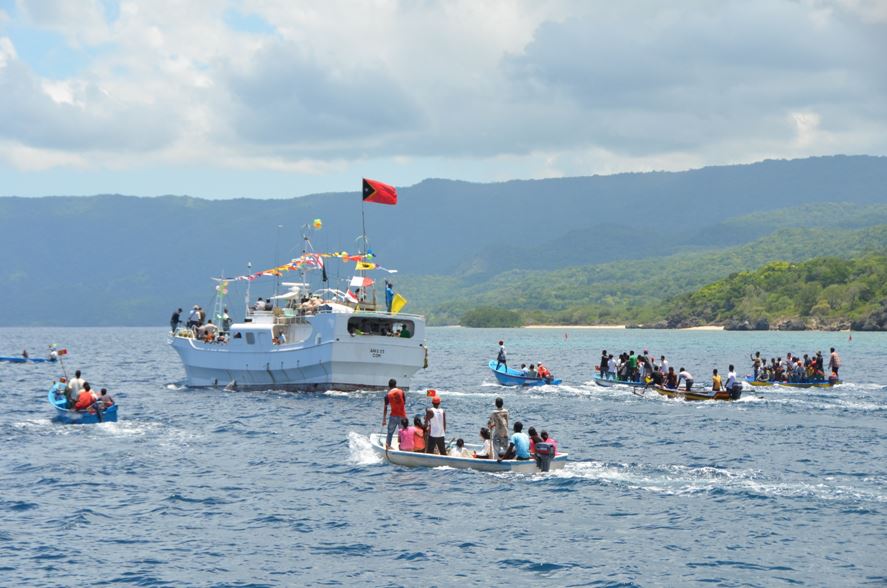
Lower Right: Local fishermen in their boats at the launch of Timor-Leste's first-ever "No Take Zones." Credit: USAID CTSP