-
News
- admin
- 04 Jul 2014
More and more, the six CTI-CFF Member States are taking ownership of The Coral Triangle Day, which has become a month-long celebration for some countries. As of this posting, partial reports indicate that this year’s celebrations started as early as May 30 and included at least 36 activities involving thousands of participants across the Coral Triangle region, including Fiji.
Reports from Indonesia say The CT Day was celebrated in at least Bali, Makassar, and Jakarta, with larger events involving some 1,000 people.
Malaysia reported at least three major events, including a sustainable seafood festival, a month-long sustainable seafood “selfie contest,” and an exhibit organized by Universiti Malaysia Sabah in the latter part of June.
In Papua New Guinea, the celebration included at least one mangrove planting activity involving students and teachers from the University of Papua New Guinea.
In the Philippines, dozens of activities were conducted throughout the month by various organizations in several towns and cities, including events initiated by the private sector.
In Solomon Islands, activities were held on June 8 to celebrate World Oceans Day and as a prelude to The CT Day, as well as on The CT Day itself.
In Timor-Leste, more than 100 people participated in a beach and underwater clean-up organized by Conservation International.
Below are four stories published in four countries to commemorate The CT Day 2014. For more snippets and images, visit The CT Day 2014 Photo Galleries.
- Indonesia: Children Celebrate Coral Triangle Day with Fun
- Malaysia: Wave to the Ocean and It Will Wave Back
- Philippines: International chef Bobby Chinn promotes sustainable seafood
- Solomon Islands: The Last Journey Home
Indonesia: Children Celebrate Coral Triangle Day with Fun
By Desy Nurhayati, Bali Daily Denpasar, June 11, 2014
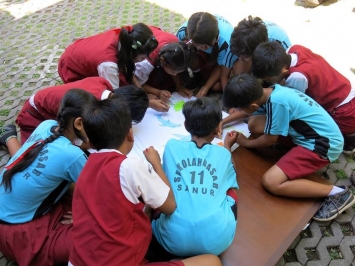
CT Day means fun and learning for these schoolchildren participating in CTC’s Open House in Bali, Indonesia (Courtesy: CTC)
As the world celebrated Coral Triangle Day on Monday, the Coral Triangle Center (CTC) held an open house for schoolchildren in Sanur to raise awareness of the importance of conserving marine environments.
The celebration brought together schoolchildren, parents, and local youth from around Sanur to participate in classes and games about marine conservation and sustainable fishing. The children were introduced to coral reefs, mangroves, seagrass ecosystems, and the species living in those habitats.
Among the highlighted issues was the importance of marine ecosystems for livelihoods, as well as the connectivity between ecosystems, such as through fish migration. In a group drawing competition, the children illustrated their own interpretation of the species and habitats that are part of marine ecosystems. Around 50 children and students took part in the games, which were followed by a prize ceremony and lunch.
“We engage schoolchildren and then introduce them to the basics of marine conservation, so they can share what they learned with their friends and family and take action,” said CTC Executive Director Ril Djohani. (To view the source article, click here [external link].)
Malaysia: Wave to the Ocean and It Will Wave Back
By Des Iskandar, Malaysian Digest, 11 June 2014
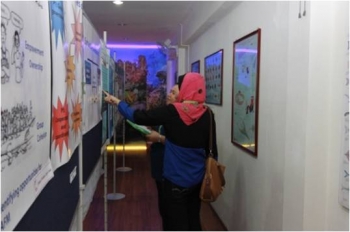
A marine-themed exhibit by Universiti Malaysia Sabah to celebrate CT Day and World Oceans Day
This year, World Oceans Day was jointly celebrated with Coral Triangle Day, based on the common theme "Together we have the power to protect the Ocean!"
The Minister of Science, Technology and Innovation of Malaysia, Datuk Dr. Ewon Ebin, said that since 2011, Malaysia has joined fellow maritime nations under UNESCO in celebrating World Oceans Day.
"To date, MOSTI (Ministry of Science, Technology and Innovation of Malaysia) has approved and is monitoring 56 research projects related to the ocean, involving a total funding of RM15.71 million," he said.
"Malaysia is also involved in various programs or initiatives on the conservation of the marine ecosystem such as the Coral Triangle Initiative (CTI), the Sulu Sulawesi Marine Ecoregion (SSME), and the Bay of Bengal Large Marine Ecosystem (BOBLME)," he further elaborated. (To view source article, click here [external link])
Philippines: International Chef Bobby Chinn Promotes Sustainable Seafood
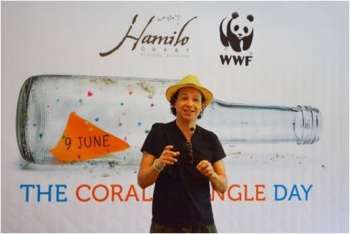
Celebrity chef Bobby Chinn pitches sustainable seafood (Courtesy: Gregg Yan/WWF)
09 June 2014, By WWF — Where does the fish on your plate come from? It is highly likely that it was sourced from the Coral Triangle, the world’s epicenter of marine life and abundance.
Every day, thousands of small fishing boats operate within this thriving marine region, whose resources sustain the lives of more than 120 million people. However, unsustainable fishing methods have damaged coral reefs and depleted fish populations throughout the region.
More than 85% of the reefs in the Coral Triangle — which spans the waters of the Philippines, Indonesia, Malaysia, Papua New Guinea, the Solomon Islands, and Timor-Leste — are directly threatened by local human activities, substantially more than the global average of 60%. Growing populations and high demand for delicacies such as shark fin soup are placing extreme pressure on the seas.
Overfishing and illegal fishing threaten coastal and marine environments, wipe out fish stocks, and compromise food security and livelihoods. For example, Pacific Bluefin Tuna (Thunnus orientalis) stocks have declined drastically. The International Scientific Committee for Tuna and Tuna-like Species in the North Pacific Ocean (ISC) reports a 96.4% decline compared to unfished levels.
To promote sustainable alternatives, WWF, Costa del Hamilo, Inc. (Hamilo Coast), and celebrity chef Bobby Chinn partnered to celebrate Coral Triangle Day in the Philippines on 9 June 2014.
“As seafood consumers, we all have a responsibility to ensure that the fish we eat comes from sustainable sources or are caught in ways that aren’t harmful to the marine environment. This helps conserve our food supply and the livelihoods of millions who depend on the ocean’s bounty,” said Chinn, a Vietnam-based chef, restaurateur, and television personality.
Celebrated in its third year, Coral Triangle Day occurs every 9 June, in conjunction with World Oceans Day on 8 June.
At Pico de Loro Cove in Nasugbu, Batangas, Chinn demonstrated cooking Yellowfin Tuna (Thunnus albacares) caught via sustainable hand-line methods from Occidental Mindoro. He also promoted local fisheries by preparing dishes from local fish sourced from Hamilo Coast. To raise awareness about shark finning, he prepared a seared snapper head dish as a sustainable alternative to shark fin soup.
“The global demand for tuna, live reef fish, and other marine products continues to grow — at a frightening environmental cost to the Coral Triangle. Through our partnership with Bobby Chinn and Hamilo Coast, we hope to emphasize the need to rehabilitate the Coral Triangle’s reefs and build sustainable livelihoods for fishermen,” said WWF-Philippines Vice President for Conservation Programs Joel Palma.
Rona Torres-Tan, Senior Vice-President for Operations at Costa del Hamilo, Inc., concluded, “Preserving the Coral Triangle is important because Hamilo Coast is at the entry of the Verde Island Passage, one of the most prolific areas of the Coral Triangle. We, along with our community of homeowners and club members, are committed to protecting the natural gifts of Hamilo Coast for years to come.”
Solomon Islands: The Last Journey Home
By Ken Lewis (TNC) and Lysa Wini (CTI), June 9, 2014 (as published in Solomon Star, reposted with authors’ permission)
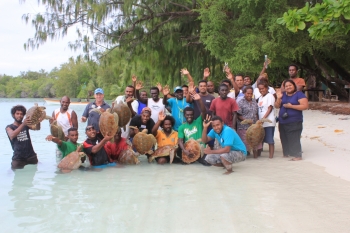
Local rangers trained to monitor turtles at Arnavon Islands (Courtesy: TNC)
In 2007, a Leatherback turtle swam from California to Isabel Province in the Solomon Islands to lay its eggs at the beach where it was born. Hunters found and killed the turtle, but a satellite tracking device attached by NOAA revealed its final journey.
“That turtle traveled over 12,000 km across the Pacific to the very same beach it hatched on. Turtles often live for 100 years or more, so that turtle had probably seen more than the man who killed it. This story shows how individual actions impact the world around us and the marine life we rely on,” said Willie Atu, Solomon Islands Programme Director at TNC.
Turtles have existed for over 200 million years, long before the dinosaurs, but are now seriously endangered. Protecting turtles also safeguards