-
News
- admin
- 01 Dec 2016
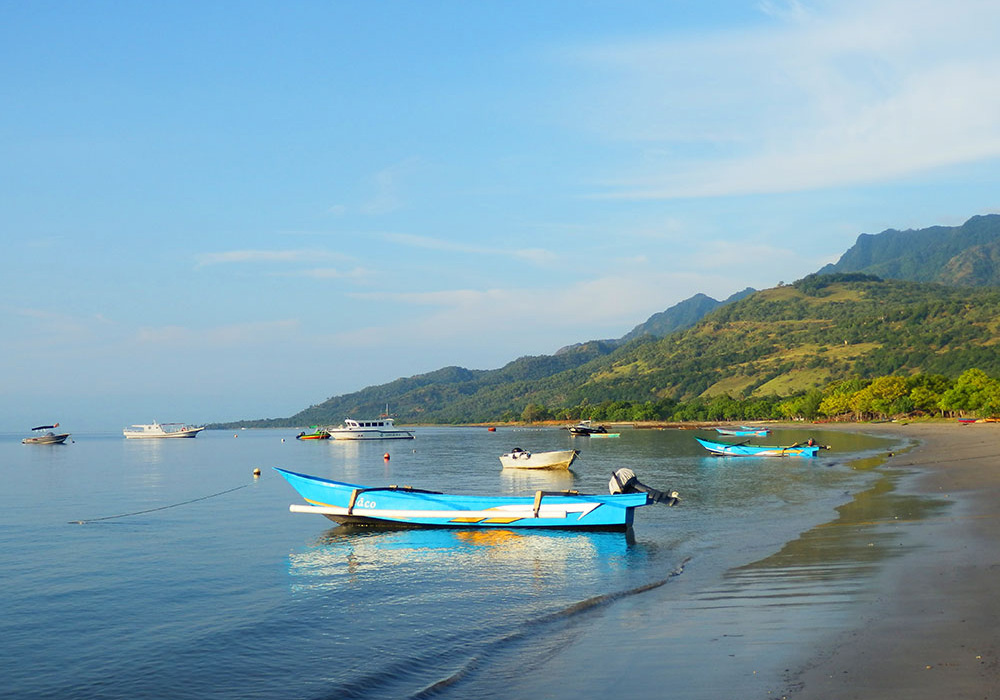
A fishing canoe at Atauro Island, Timor-Leste. (Photo credit: Carl Solomon/Destination Marketing Store)
By Lida Pet-Soede, PT Hatfield Indonesia
Since the establishment of the CTI-CFF in 2009, popular media and scientific papers have come out to confirm something that hundreds of thousands of travellers to the Coral Triangle already knew: Coastal areas, islands and the village communities and wildlife around this vast region provide plenty of opportunity for action-packed adventures, special encounters with different cultures and unique ways to be inspired by the beauty of this region’s biodiversity and people.
Tourism has become an economic growth engine and vehicle for development in the region. This has not come without negative impacts particularly in mass tourism destinations but fortunately, ‘nature-based’ and ‘eco’ tourism have also seen rapid growth. Nature-based and adventure tourism are growing annually by 10–30%, currently accounting for up to 25% of the world’s tourist market according to the UNWTO. This provides an argument to minimize impacts of mass tourism in areas with high conservation value and invest instead in the preservation of natural areas and support for community stewardship over their reefs and coastal environments.
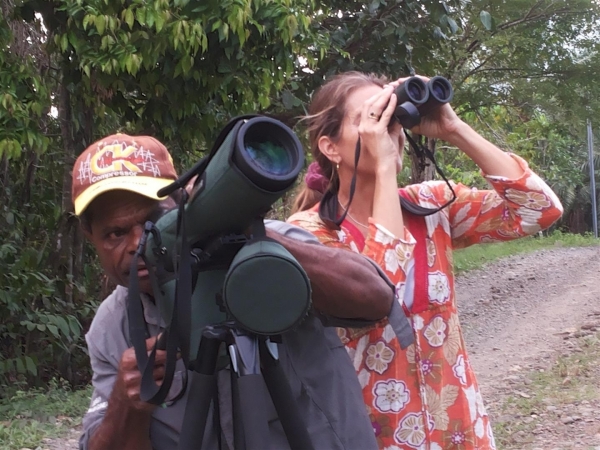
Bird watching with Joseph (Photo credit: Jackie Thomas of WWF)
In recent years, tourism related coastal developments increased rapidly across the region, particularly in areas of high conservation value that appeal to the visitor looking for a beach holiday “off the beaten track” or scuba-diving. This is due to many factors, including increased accessibility of some areas from airport or harbor infrastructure developments and the demographic growth of financially-able domestic and international travellers. However, rapid and poorly planned coastal development is putting pressure on available resources and polluting coastal ecosystems. The very developments that are being established to entice visitors can damage the very resources the visitors are coming to see.
As the six CTI-CFF countries are at varying stages of tourism development (WWF Coral Triangle Report), the wide range of benefits and risks inherent with tourism can be found in each country. Whilst each has unique challenges and opportunities, the CTI-CFF provides a unique opportunity to work together and use the growing potential of Coral Triangle tourism to benefit conservation of important places and provide for community needs.
A key objective of the CTI-CFF is to encourage industries that depend on the Coral Triangle’s resources to co-invest in the ocean’s natural capital, thereby securing their business. Examples do exist of low impact, low volume, sustainable, high value or high profile nature-based tourism in the Coral Triangle. These range from small-scale local enterprises catering to the backpacker market, to high-end eco-lodge, cruise and liveaboard operations. The low-end local enterprises tend to serve a small not-well organised market of backpackers and more adventurous travellers that go to great lengths to visit remote areas where nature and wild life are relatively untouched. Some of these enterprises are initiated by local communities or engage local communities throughout the enterprise. Conversely the higher-end operations existing in the region have generally been developed with international investment, establishing their brand through marketing the unique high value nature and community related experience for elite travellers.