-
News
- admin
- 16 Jul 2012
Indonesia's Leading Scientist Calls for Stronger Science-to-Management Approach in Protecting the Coral Triangle
Source: Coral News, July 10, 2012
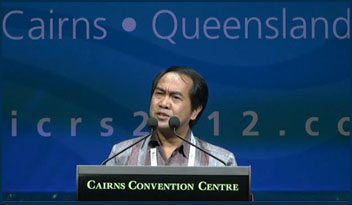
The threat to reefs in the Coral Triangle (CT) by 2050 is “so scary I don’t want to believe it,” leading Indonesian scientist Professor Jamaluddin Jompa said in his plenary address on July 9, 2012, at the 12th International Coral Reef Symposium in Cairns, Australia.
“It will be the end of the Coral Triangle story if it ever comes true,” predicted Professor Jompa, who is Director of Coral Reef Research at Hasanuddin University in Makassar. Some 90 percent of regional reefs would be threatened by 2050, he said, citing findings in a new report, Reefs at Risk Revisited in the Coral Triangle, published by the World Resources Institute.
He described the CT—a region of six countries—as the “Amazon of the Sea,” and said his own country, Indonesia, was in the “bull’s eye of its biodiversity.” The Coral Triangle Initiative (CTI) embraces the Solomon Islands, Papua New Guinea, Indonesia, the Philippines, Timor-Leste, and Malaysia.
Delegates heard that 50 percent of all tuna stocks exist within the CT, which also features the “greatest mangrove forests in the world.” Some 85 percent of reefs face the combined threats of climate change and local excesses such as overfishing and destructive fishing practices. About 5 percent of Coral Triangle reefs face threats solely from global climate change, he said.
He expressed shock at the “major bleaching” that Indonesian reefs suffered in 2010. “Many reefs suffered this for the first time in their history,” he said. “Indonesia has so many problems with its reefs, and now we have bleaching from Aceh to Raja Ampat.”
“A presidential advisor asked me how we could make the coral stronger, but it struck me that we should not be asking the coral to keep up with these ecological changes. The challenge for scientists is to come up with solutions for decision-makers.”
Professor Jompa said, “Science must bring the knowledge, but management and policy makers bring the authority to act. Science needs to find the best solution, but it is the people who need to be managed.” He added that management in Indonesia had become “so complicated,” requiring the science community to adjust its approach.
“Science is motivated by discovery,” Professor Jompa said. “Management is concerned with the public. We cannot claim to be the same. Culturally, we have different motivators.” To enhance marine ecosystems in Indonesia, Professor Jompa said the challenges of overfishing and destructive fishing must be top priorities.
“These and other emerging pressures—such as bleaching, crown-of-thorns starfish, coral mining, sedimentation, and pollution—have degraded coral reefs and coastal ecosystems throughout the region in recent decades.”
Watch the video of Professor Jompa's talk at the ICRS website: http://www.icrs2012.com/