-
News
- admin
- 31 May 2014
The first four flagship sites of the Coral Triangle Marine Protected Area System (CTMPAS) were unveiled on May 13 during a launch event held on the sidelines of the World Coral Reef Conference in Manado, Indonesia.
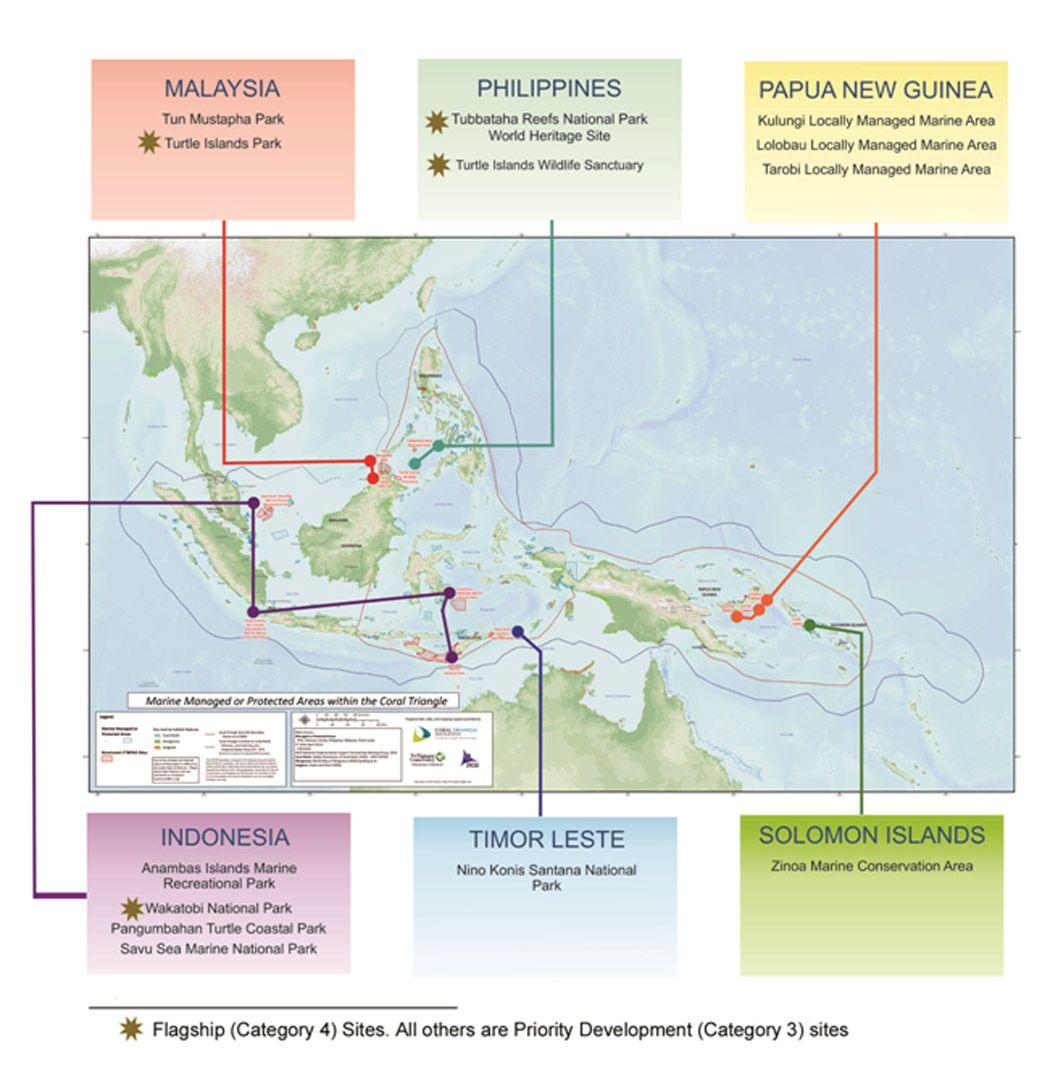
The four sites – Wakatobi National Park in Indonesia, Turtle Islands Park in Malaysia, and Turtle Islands Wildlife Sanctuary and Tubbataha Reefs National Park World Heritage Site in the Philippines – were assessed to have met the criteria under the CTMPAS Framework and Action Plan for “Category 4: Flagship Sites.” These are defined as “large, already effectively managed sites that have regional ecological, governance, and socioeconomic importance.”
Nine other nominated sites were assessed as “Category 3: Priority Development Sites.” These sites do not yet meet the Category 4 management effectiveness criteria but are proposed as priority sites for conservation and technical assistance due to their regional ecological, governance, or socioeconomic significance. They include:
- Anambas Islands Marine Recreational Park, Indonesia
- Pangumbahan Turtle Coastal Park, Indonesia
- Savu Sea Marine National Park, Indonesia
- Tun Mustapha Park, Malaysia
- Kulungi Locally-Managed Marine Area (LMMA), PNG
- Lolobau LMMA, PNG
- Tarobi LMMA, PNG
- Zinoa Marine Conservation Area, Solomon Islands
- Nino Konis Santana National Park, Timor Leste
The CTMPAS is designed to scale up and maximize the food, income, and ecological benefits of marine protection and management through adoption of regional criteria for management effectiveness. It is being developed by the CTI-CFF countries as part of their commitment to address threats to the sustainability of coastal and marine resources in the Coral Triangle, including key species and habitats that span national boundaries.
In an interview after the launch, Dr. Vincent Hilomen, a reef fisheries expert and Executive Director for Priority Programs at the Biodiversity Management Bureau of the Philippines’ Department of Environment and Natural Resources, described CTMPAS as a “very bold idea.”
“If, as we hope, the CTMPAS results in improved management for each of the individual MPAs in the Coral Triangle, the ecological, governance, and socioeconomic benefits from these MPAs will accrue regionally,” said Dr. Hilomen, who represented the CTI-CFF MPA Technical Working Group Chair, Ms. Mundita Lim, at the launch.
The May 13 launch also celebrated five years of collaboration by the countries and their development partners, including the U.S. Agency for International Development, the U.S. National Oceanic and Atmospheric Administration, The Nature Conservancy (TNC), World Wide Fund for Nature, and Conservation International.
Click here to view a map showing the locations of all 13 sites.