-
News
- admin
- 16 Aug 2016
The Coral Triangle is known to be one of the most biologically diverse and ecologically rich regions on earth. To safeguard these rich and fragile coastal and marine biological resources, the governments of Indonesia, Malaysia, Papua New Guinea, Philippines, Solomon Islands, and Timor-Leste (CT6) entered into a multilateral partnership, the Coral Triangle Initiative on Coral Reefs, Fisheries and Food Security. To address the various threats to the coastal and marine environment of the Region, the CT6 adopted a 10-year Regional Plan of Action (CTI RPOA) which contains five strategic goals, among which is, “to establish a region-wide comprehensive, ecologically representative and well-managed Coral Triangle Marine Protected Area System (CTMPAS) by 2020.”
To guide the development and implementation of the CTMPAS, the MPA Technical Working Group (MPA-TWG) was created in 2011 and serves as the coordinating body among the CT6 MPA Focal Points, Regional Secretariat, and partners. The MPA Working Group prioritized the development of the overall goals, objectives, principles, and operational design elements of the CTMPAS Framework, centered on priority MPAs and MPA Networks. Its development is guided by five (5) basic strategies: 1) Use and strengthen existing regional mechanisms, partners, and programs; 2) Prioritize activities that develop effective MPAs and Networks; 3) Start and learn with “flagships” MPAs; 4) Define and recognize four categories of Sites in the CTMPAS; and 5) Direct governance and socioeconomics. It also revolves around three recurring themes: 1) Ecology, 2) Governance, and 3) Society. It is also composed of short and long-term Regional Actions that were endorsed by the CTI-CFF during their 7th Senior Officials Meeting in 2012.
The Regional Secretariat has received a confirmation letter dated 29 July 2016 from the Government of Papua New Guinea to host the upcoming SOM-12 and MM-6.
The inclusion of MPAs and MPA networks in the CTMPAS will be based on their regional value, uniqueness or importance, and the level of management effectiveness they achieved in meeting basic criteria as MPA sites or networks. There are four site categories that comprise the CTMPAS:
Category 4: Flagship Sites – large, effectively managed sites that have exceptional regional importance in ecology, governance, or socioeconomic aspects; highest level criteria for management effectiveness.
Category 3: Priority Development Sites – sites of high regional ecological, governance, or socioeconomic importance that are not yet effectively managed and thus need additional assistance.
Category 2: Effectively Managed Regional Sites – contributing to CTMPAS objectives at national or regional levels; existing sites that meet agreed minimum criteria for design and management effectiveness as specified in the CTMPAS Framework.
Category 1: Recognized CTMPAS Sites – sites that are contributing to CTMPAS objectives at the local level; meet the minimum data and are included in the CT Atlas.
Four CTMPAS site categories:

The CTMPAS will consider all recognized MPAs and Networks within the Region which qualify by level of accomplishments, contribution, and purpose. The MPAs under Categories 1 and 2 will be selected by the countries based on their own internal management effectiveness monitoring system and the criteria as prescribed in the CTMPAS Framework. On the other hand, the site nominations for Categories 3 and 4 need to be endorsed by the respective CT6 and reviewed by the Regional Advisory Committee. The CT6 shall register or update their respective MPA information to the CT Atlas. The overall site nomination and selection process is provided in the CTMPAS Framework (pages 43–45).
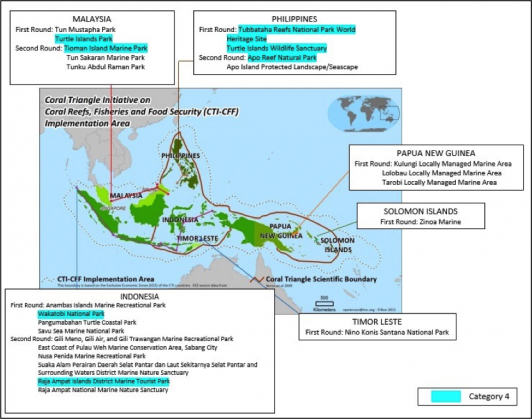
The CTMPAS nomination and site selection was launched in 2014 wherein four sites — Wakatobi National Park in Indonesia, Turtle Islands Park in Malaysia, and Turtle Islands Wildlife Sanctuary and Tubbataha Reefs National Park World Heritage Site in the Philippines — met the criteria set out under “Category 4: Flagship Sites,” defined as large, effectively managed sites with regional ecological, governance, and socioeconomic importance. The other nine nominated sites were assessed as “Category 3: Priority Development Sites,” or sites that do not meet the CTMPAS management effectiveness criteria for Category 4 but are proposed as priority sites for conservation and technical assistance because of their regional importance. These include:
- Anambas Islands Marine Recreational Park, Indonesia
- Pangumbahan Turtle Coastal Park, Indonesia
- Savu Sea Marine National Park, Indonesia
- Tun Mustapha Park, Malaysia
- Kulungi Locally-Managed Marine Area (LMMA), PNG
- Lolobau LMMA, PNG
- Tarobi LMMA, PNG
- Zinoa Marine Conservation Area, Solomon Islands
- Nino Konis Santana National Park, Timor-Leste
The second round of CTMPAS nomination and site selection for Categories 3 and 4 was conducted in 2015, wherein Indonesia nominated eleven sites, Malaysia endorsed three, and the Philippines endorsed two. Those rated as Category 4 Flagship Sites were Raja Ampat Islands District Marine Tourism Park (Indonesia), Tioman Island Marine Park (Malaysia), and Apo Reef Natural Park (Philippines), due to their regional ecological, governance, and social significance, as well as their important roles in habitat and species conservation. These MPAs have also established a threshold level of effective management with regular biophysical and socioeconomic monitoring.
The other nominated sites qualified to Category 3 are as follows:
- Gili Meno, Gili Air, and Gili Trawangan Marine Recreational Park, Indonesia
- East Coast of Pulau Weh Marine Conservation Area, Sabang City, Indonesia
- Nusa Penida Marine Recreational Park, Indonesia
- Suaka Alam Perairan Daerah Selat Pantar dan Laut Sekitarnya (Selat Pantar and surrounding waters District Marine Nature Sanctuary), Indonesia
- Raja Ampat National Marine Nature Sanctuary, Indonesia
- Tun Sakaran Marine Park (TSMP), Malaysia
- Tunku Abdul Rahman Park, Malaysia
- Apo Island Protected Landscape/Seascape, Philippines
The content from Microsoft Word has been cleaned successfully. You can now add your actual text here without any hidden Word formatting or XML tags.
Map showing the Distribution of CTMPAS Sites (Categories 3 and 4).
The MPA Working Group will have its 6th Regional Exchange on September 12–16, 2016 and MPA TWG Meeting in Dumaguete City, Philippines. The overall theme of the 6th MPA REX will be “Sustainable Marine Tourism in the CTI-CFF MPAs” as a take-off from the 4th CTI-CFF Regional Business Forum held in 2015, and will attempt to introduce sustainable marine tourism in the CT Region. The objectives of the 6th MPA REX include:
- Review the progress on the implementation of the CTMPAS Framework (CTMPAS nomination process, CT Atlas training, Recognition of CTMPAS Sites);
- Review the implementation of the CT6 roadmap prepared during the 5th MPA REX;
- Review the status of MPA Management Effectiveness Assessment Tools in the CT6;
- Share concepts, knowledge, and practices on Sustainable Tourism in MPAs that contribute to and build on the Coral Triangle MPA System;
- Review the draft Terms of Reference of the CTI-CFF Marine Tourism Task Force;
- Conduct a study tour to an MPA learning site on sustainable tourism in the Philippines; and
- Develop the Agenda for the 6th MPA TWG Meeting.
The Regional Secretariat has received a confirmation letter dated 29 July 2016 from the Government of Papua New Guinea to host the upcoming SOM-12 and MM-6.
Reference: Coral Triangle Initiative on Coral Reefs, Fisheries and Food Security (CTI-CFF). 2013. Coral Triangle Marine Protected Area System Framework and Action Plan. CTI-CFF, United States Agency for International Development Coral Triangle Support Partnership and US National Oceanic and Atmospheric Administration, Cebu City, Philippines. 75 pp.