-
News
- admin
- 28 Dec 2016
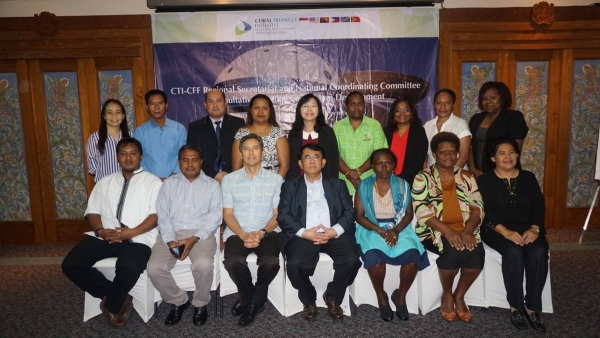
A 2-day Consultative Meeting in Bali between RS CTI-CFF, NCCs Member States and Development Partner
Following up the recommendations of the Member States during SOM-12 and the 6th Ministerial Meeting to share and consult with the CT6 over future activities and programs, the Regional Secretariat organized a consultative meeting between the representatives from the CT6 Member States with relevant Development Partners. The objectives of the meeting are to obtain NCC’s insights and guidance to improve the proposed work plans and identify gaps; while keeping in mind the targets of the Regional Plan of Action (RPOA).
The meeting program was planned over two-days; from 2-3 December 2016 in Bali, Indonesia, immediately after the Seascape Working Group Meeting led by Conservation International. The meeting was attended by NCC representatives from Indonesia, Malaysia, Papua New Guinea, Solomon Islands, and Timor-Leste; the Chair of the Local Government Network (LGN); Development Partners - the United States Agency for International Development (USAID); and World Wide Fund for Nature (WWF).
The first day of the meeting focused on the potential support from USAID Regional Development Mission for Asia (RDMA) based on the draft USAID/CTI Work Plan. The agenda for the second day focused on the discussion over the Terms of Reference for the 3rd Fisher Forum; the Regional Workshop on the Sustainable Management of Shared, Straddling and Highly Migratory Fish in the Coral Triangle Region (Tuna Governance); the COASTFISH Workshop; and CTI-CFF University Partnerships for Capacity Building.
The United States Agency for International Development (USAID) was represented by Mr. Alfred Nakatsuma, the Regional Environment Office Director. In essence, Mr. Alfred explained to the meeting that USAID is very keen to continue supporting the Coral Triangle Initiative since the Coral Triangle Support Program (CTSP) ended in 2013.
On August 5, 2015, Secretary of State John Kerry announced that the U.S. Agency for International Development's Oceans and Fisheries Partnership (USAID Oceans) project with an initial commitment of $4.3 million that will combat illegal, unreported, and unregulated (IUU) fishing and seafood fraud in the Asia-Pacific region.
"The catch documentation and traceability system established by USAID Oceans will improve the transparency of Asia's seafood supply chains, ensuring that fish is legally and sustainably harvested," said Secretary Kerry at the 22nd Association of Southeast Asian Nations Forum in Kuala Lumpur, Malaysia. "Traceability is an essential part of our global fight to conserve marine resources and protect the health of our oceans."
USAID is partnering with the Southeast Asian Fisheries Development Center (SEAFDEC) and the Coral Triangle Initiative (CTI) to strengthen regional, sustainable fisheries management by developing an electronic catch documentation and traceability system to track species at a high risk of being illegally traded or mislabeled. This system will harness the latest science, technology, and innovation to ensure that fish, shrimp and other marine resources are legally caught and properly labeled. Eliminating IUU fishing, which undermines efforts to conserve and manage shared fish stocks, will level the playing field for legitimate fishers and ensure the sustainability of our shared ocean resources (find link here).
In addition, Mr Alfred informed the meeting that in December, a final rule shall be announced to implement the Seafood Import Monitoring Program to address illegal fishing and seafood fraud in the United States. The final rule will require imported seafood at risk of illegal fishing and seafood fraud to be traced from the fishing boat or farm to the U.S. border, helping to stop illegally caught and mislabeled seafood from entering the United States (please see here for more information).