-
News
- admin
- 15 Jan 2013
Fifty-two government and private sector representatives from Indonesia, Malaysia, Philippines, Solomon Islands, Timor-Leste, and Vietnam attended an inter-governmental forum in Bangkok, Thailand, on January 31–February 1, 2013. They developed a concrete roadmap to address the negative impacts of the live reef fish trade in the Coral Triangle region. The forum was organized by USAID’s US Coral Triangle Initiative (CTI) Support Program in collaboration with the CTI Interim Regional Secretariat and the Southeast Asian Fisheries Development Center (SEAFDEC).
iinvolved in live reef fish tr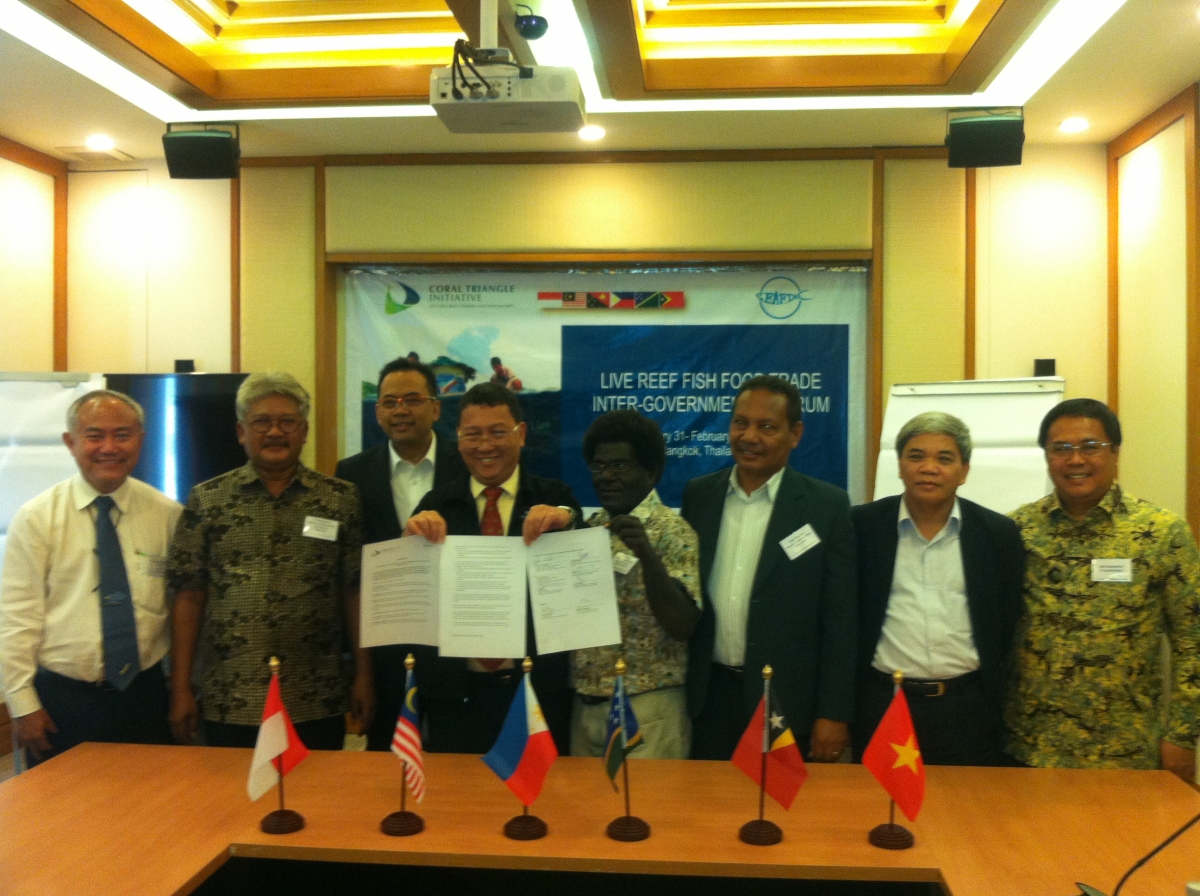 ade trade; develop an accreditation system designed to encourage live reef fish At the end of the forum, government representatives from the six countries signed a resolution to establish marine protected areas that will protect fish species involved in the live reef fish trade; develop an accreditation system designed to encourage suppliers to follow sustainable and fair trade practices; consider developing a reporting system to capture relevant data and support traceability; address illegal, unregulated, and unreported fishing practices; and promote collaboration among participating countries.
The trade in live reef food fish in the Coral Triangle represents one of the biggest threats to coastal and marine environments, characterized by overfishing, illegal fishing practices, and unsustainable mariculture that largely remain unaddressed at the regional level.
Mr. Matheus Eko Rudianto, Vice Chair of the CTI-CFF Interim Regional Secretariat for Coordination and External Affairs, highlighted the summary from the Workshop on Market-based Improvements in Live Reef Fish Food Trade (LRFFT) held in Bali in 2011. “As a pervasive industry, the live reef fish trade in our region has specific and complex characteristics. I believe such collaboration and experience sharing can serve as a backbone to address challenges in live reef fish trade, achieve our RPOA goals, and support sustainable practices in the industry. I welcome the proposal for a multi-stakeholder forum on live fish trade as an informal dialogue and partnership mechanism to share information and advance a collaborative work program on live reef fish food trade,” he added.
“We applaud this positive move of governments to come together to tackle common issues critical to the live fish trade in the Coral Triangle region,” said Dr. Geoffrey Muldoon, WWF Coral Triangle Global Initiative Strategy Leader. “We are especially buoyed by the delegates’ decision to pursue the establishment of a regional intergovernmental forum to improve management of the live reef fish trade. This forum presents an effective platform to bring government commitments in this region to life,” he added.
“The establishment of this intergovernmental forum comes at a time when we see even more alarming issues emerging in the trade,” said Dr. Chumnarn Pongsri, Secretary General of SEAFDEC. “Coral Triangle governments should use this forum to demonstrate their collective commitment to improving trade management and to stabilize the welfare of their shared ecosystems and resources for the benefit of millions of people who depend on them for food and livelihoods,” he added.
Reef fish are a highly valuable resource whose unsustainable trade is driven by rising demand for seafood, mainly in Hong Kong and mainland China. High-value species such as Humphead wrasse can sell for as much as HK$250 per kilo in Hong Kong and over US$500 per kilo in Beijing and Shanghai. The trade has been estimated to be worth around US$800 million.
Follow this link to download a copy of the declaration, this link to obtain an electronic copy of the forum proceedings, and this link to see more photos from the event.
Photo Caption: Representatives from SEAFDEC and CTI-CFF at the signing of the live reef fish trade resolution (L-R): Dr. Chumnarn Pongsri, Tri Hariyanto, Mohamed Razali, Asis Perez, Alex Meloty, Julio Da Cruz, Pham Anh Tuan, and Eko Rudianto. Credit: US CTI