-
News
- admin
- 20 Feb 2018
Marine plastics debris is becoming a major concern globally. As early as 2015, a research published in the journal Science ranked the top 20 plastic polluters and found that most of the plastic entering the ocean comes from China, followed by Indonesia, Philippines, Vietnam, and Sri Lanka. The study found that China, being the highest contributor to plastic marine debris, contributed ca. 1.32 to 3.52 million tonnes a year, and Indonesia ca. 0.5-1.3 million tonnes per year (Jambeck et al., 2015). "That's a function of the mix of population size and the level of development in the country," says ecologist Dr. Chris Wilcox, from CSIRO.
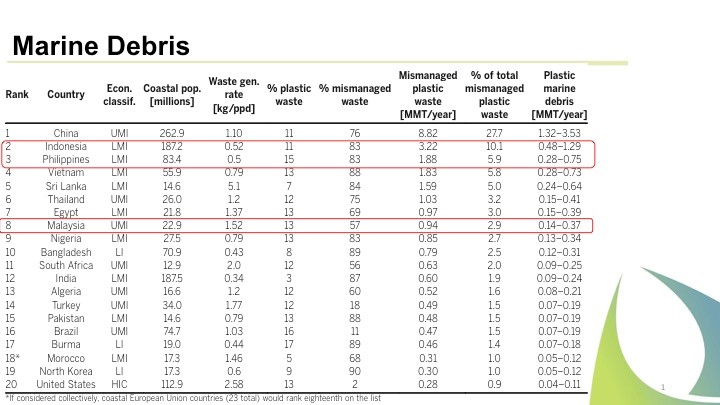 (Source: Jambeck, J. R., et al. “Marine Pollution”. Plastic Waste Inputs from Land into the Ocean. Vol. 347, pp. 768–771.)
Indonesia, for example, now has a National Plan of Action on Controlling Marine Debris in Indonesian Waters 2017–2022. Its national strategies include:
- Increase public awareness, law enforcement, and inclusive participation from multi-stakeholders
- Controlling discharges of marine debris in terrestrial and coastal areas
- Controlling discharges of marine debris into marine waters
- Institutional Strengthening
What can Individuals in CTI countries do?
- Organize or participate in Beach Clean ups
- Reduce usage of products with plastic packaging
- Lobby your local authorities, governments, and plastic industries to implement measures to reduce, reuse, recycle plastic wastes. Examples:
- Put value on plastic wastes, including bottles: Germany puts a price of 25 Euro cents on each plastic bottle with the recycle logo and barcode, and supermarkets have machines to accept returns, issuing vouchers redeemable for cash.
- Complement the above with waste separation, collection, and processing via plastic recycling facilities.
- Charge money for plastic bags: One year after the State of Israel introduced a law requiring supermarkets to charge customers for plastic bags, usage dropped by 80%, and bag waste in the sea halved.
https://www.unenvironment.org/news-and-stories/story/just-one-year-israel-halves-plastic-bags-found-sea
BEACH CLEAN UPs:
Many beach clean ups are organized by CTI countries. Indonesia and Malaysia, for example, participate in the annual International Beach Clean Up day in September. Organizers and participants can contribute information for Beach Clean Ups research. For example:
- App: https://oceanconservancy.org/trash-free-seas/international-coastal-cleanup/cleanswell/
- Individual Collector's Form: PDF Link
- Cleanup Coordinator Form: PDF Link
For example, Reef Check Malaysia organized a Beach Clean Up on 3rd March 2018 at several locations to raise awareness and collect data for dialogue with the government and plastic manufacturers. ReefCheck Philippines and ReefCheck Indonesia may have similar campaigns.
March beach clean-up in Malaysia
In conjunction with the International Year of Reef 2018 global campaign, Reef Check Malaysia kicked off a beach clean-up on the 3rd of March 2018 across 10 locations including Tioman, Mantanani, Sibu Tinggi, Pangkor, Perhentian, and Mabul. The clean-up highlighted the threat of marine plastic waste.
For more information, contact wecare@reefcheck.org.my or visit www.reefcheck.org.my.
In March–April in Manado, the 13th Celebrate the Sea festival will feature an underwater photography contest against marine plastic debris, organized by Ocean Geographic.
http://www.celebratethesea.oneocean.com/index.php/festivals/2018