-
News
- admin
- 12 Feb 2024
The South China Sea (SCS), covering 3.5 million sq.km of the Pacific Ocean, is highly important for fisheries and marine ecosystem services. The SCS hosts more than half of the world’s fishing vessels, employing approximately 3.7 million fishers. Researchers have noted that fisheries and marine resources in the SCS have been declining over the years, with catch rates depleted by 70–95 percent since the 1950s and 66–75 percent over the last 20 years, largely due to uncontrolled fishing pressures.
From January 16–19, 2024, the CTI-CFF Regional Secretariat was invited to Manila, Philippines, to participate in the South China Sea Regional Exchange (REX) on Fisheries Governance. Supported by the USAID Regional Development Mission for Asia (RDMA), the exchange provided a platform to discuss the state of South China Sea fisheries and sub-regional patterns in fisheries management. Participants included CTI-CFF, the ASEAN Secretariat Working Group on Fisheries (ASWGFi), and the Regional Plan of Action to Combat Illegal, Unreported, and Unregulated Fishing in the Southeast Asia Region (RPOA-IUU). The goal was to strengthen regional fisheries management collaboration among ASEAN member states bordering the SCS and relevant partner organizations.
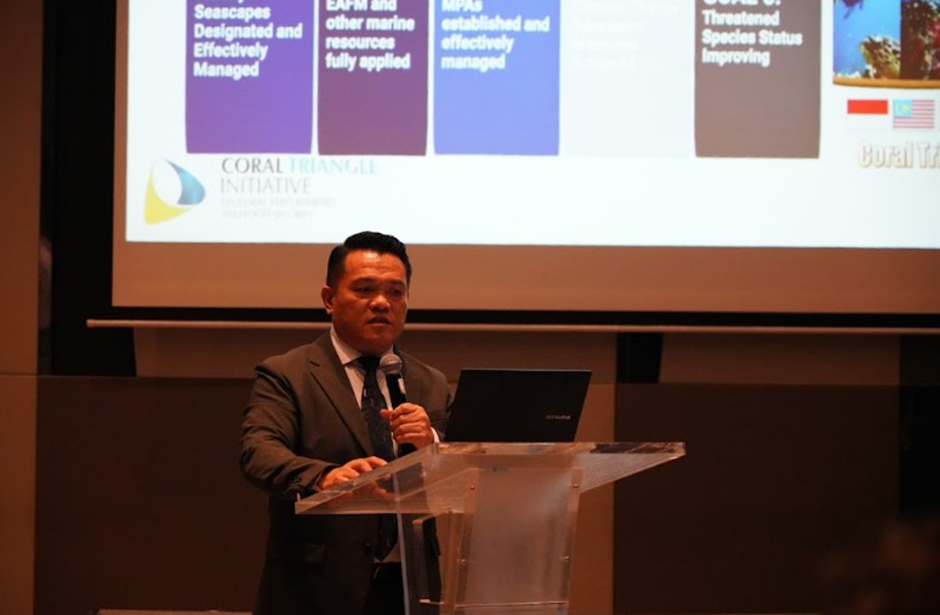
CTI-CFF, represented by Mr. Christovel R.S. Rotinsulu, Acting Executive Director of the Regional Secretariat, joined Session 3 on the second day, titled “Defining the Priority Needs for South China Sea Fisheries Management: Regional Presentations.” Mr. Rotinsulu presented updates on the CTI-CFF Regional Plan of Action (RPOA) 2.0 and related initiatives in the South China Sea/Sulu-Sulawesi Seascape.
The SCS REX concluded with a plenary session to identify next steps for establishing a regional network of government fisheries officers, fisheries managers, scientists, and other key stakeholders. This collaboration is expected to foster new alliances and cooperation in the South China Sea region. The envisioned network aims to address emerging threats and leverage opportunities through targeted sub-regional efforts, emphasizing shared sustainability and responsible fisheries management in the dynamic maritime landscape.